Bar counting is useful for two things: calibrating the strength of momentum, and reading the eagerness of market participants to push price in a given direction. It also gives traders a shared language for discussing price action — a precise way to describe what is happening on a chart.
What follows is the Seido methodology. As with everything at Seido, the definitions are deliberately clear so that ambiguity is removed from execution.
Where Bar Counting Applies
Bar counting applies to momentum. It does not apply inside a tight trading range.
Without recent momentum, inside a range, traders are responding to the boundaries — the high and the low. The focus belongs on how price is behaving at those extremes, not on counting bars. Our traders use the Seido Indicator — when it shows clear momentum, bar counting applies. Where it does not, the HTF provides the relevant context.
Defining a Pullback
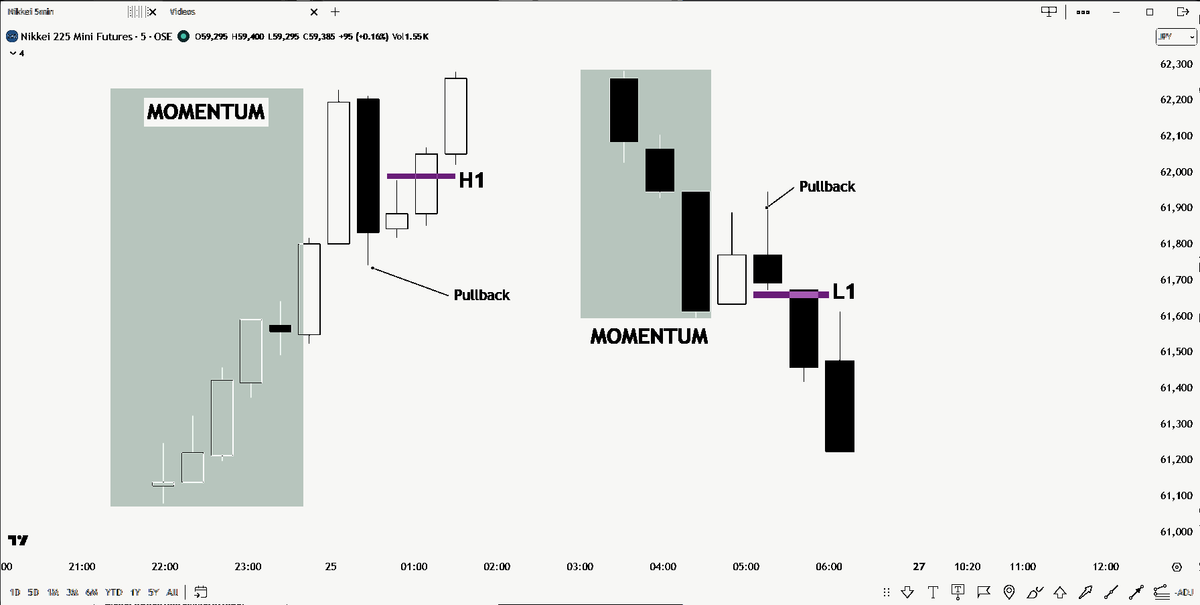
Before counting can begin, a pullback needs to be defined. A pullback is any candlestick that trades below the low of the prior candle in a bull trend — or above the high of the prior candle in a bear trend. After a pullback occurs, traders start counting highs and lows until the reference high or low is exceeded.
H1 and L1
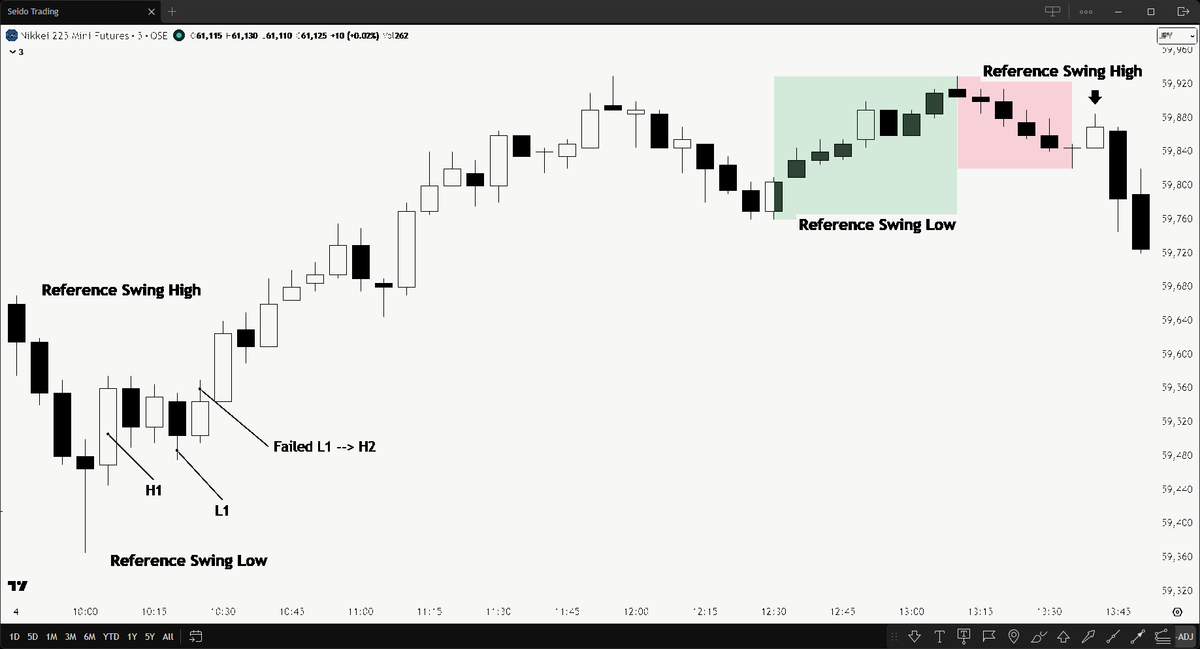
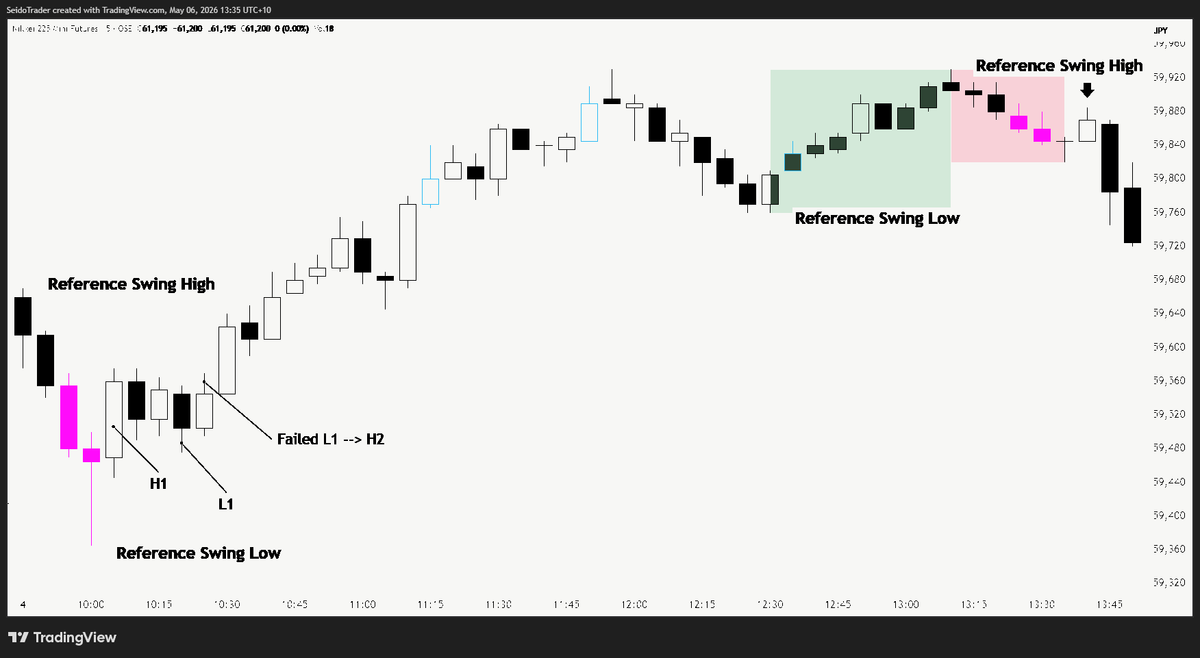
An H1 is the first candle to create a new high after a pullback. After a pullback in a bull trend, traders are watching for the first candlestick to trade above the high of the prior candle. That is the H1 — the first new high after the pullback.
In a bear trend the same logic applies in reverse. After a pullback, the first candlestick to trade below the low of the prior candle is an L1 — the first new low after the pullback.
H2 and L2
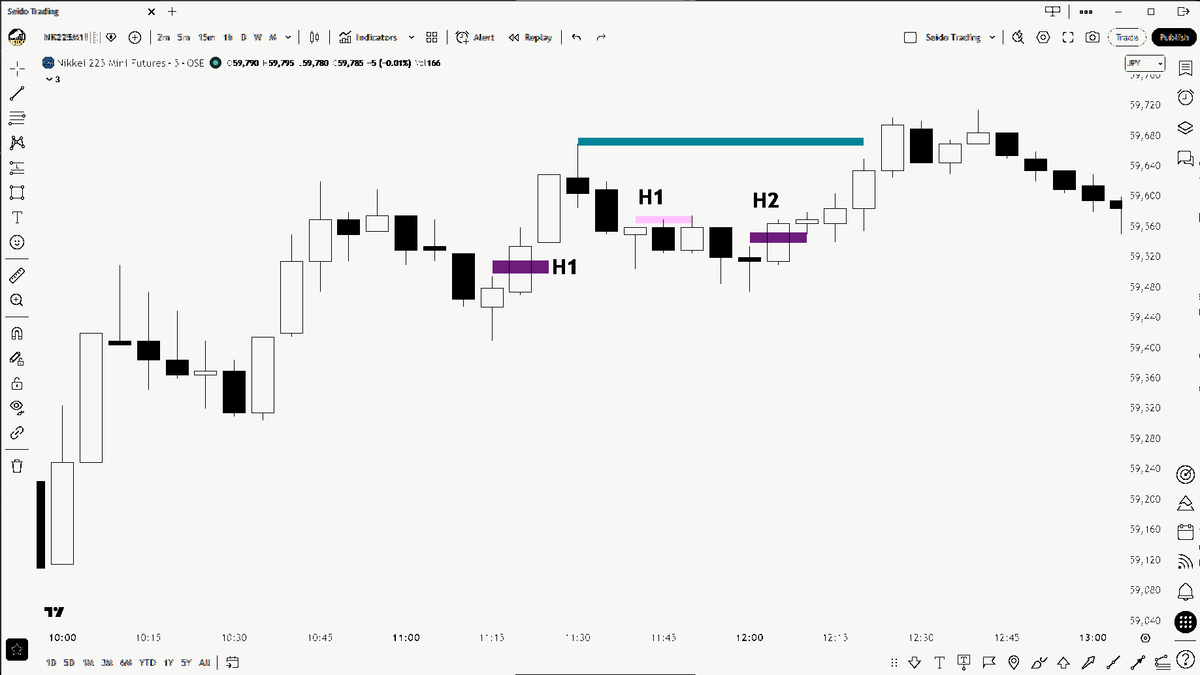
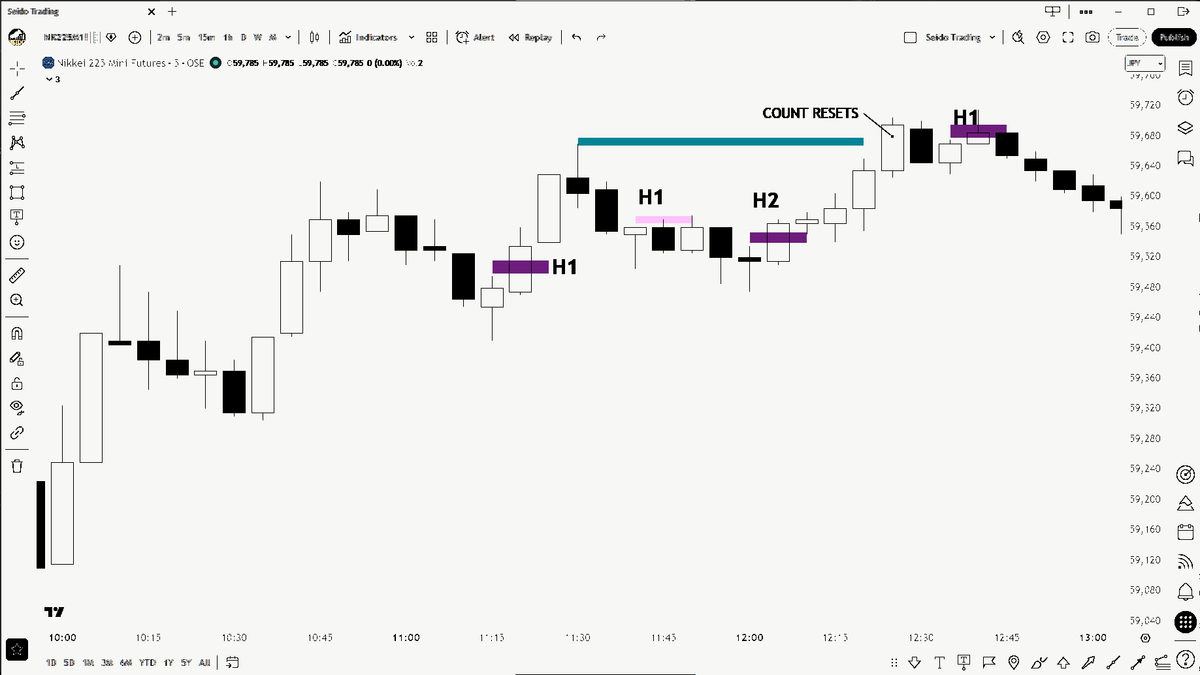
Sometimes price has a subsequent pullback before it trades through the swing high. When that happens, the count continues. The next new high becomes an H2 — the second attempt by the bulls to push price higher and through the reference high.
It is price trading beyond the swing high that resets the count. When price trades through the reference high, a subsequent pullback then creates a new H1 — not an H2. An H2 only occurs when a second pullback happens before the reference high has been exceeded.
An H2 is not a sign of weakness on its own. But it does tell traders something — the bulls needed two attempts. That is a different read to a market where every H1 is immediately pushing through the reference high. The same applies for the bears: an L2 is the second attempt to drive price lower after a second pullback before the reference low is exceeded.
H3, L3, and Beyond
When a count reaches three or beyond, the bar count itself becomes less important than what is happening on the higher timeframe. Context on the larger timeframe carries more weight at that stage than any implied momentum continuation. The right response is to step back, move up to the HTF, and read the market cycle from there.
Reading Momentum Through the Count
Bar counting gives traders a consistent and measurable way to read the strength of a trend. Momentum that pushes through to a new high off an H1 is strong — the bulls had the relative strength to force a new high. That is directional conviction. When the count moves to an H2 before the reference high is exceeded, the momentum is weaker, and that tells a story about where the market is in its cycle.
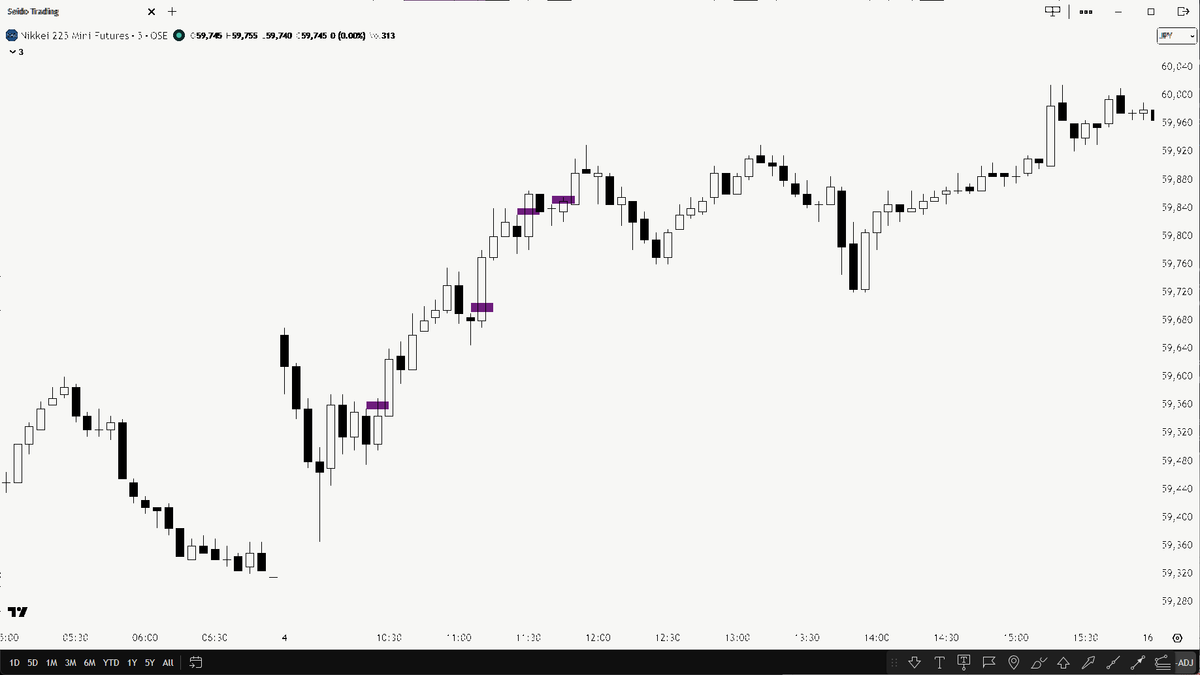
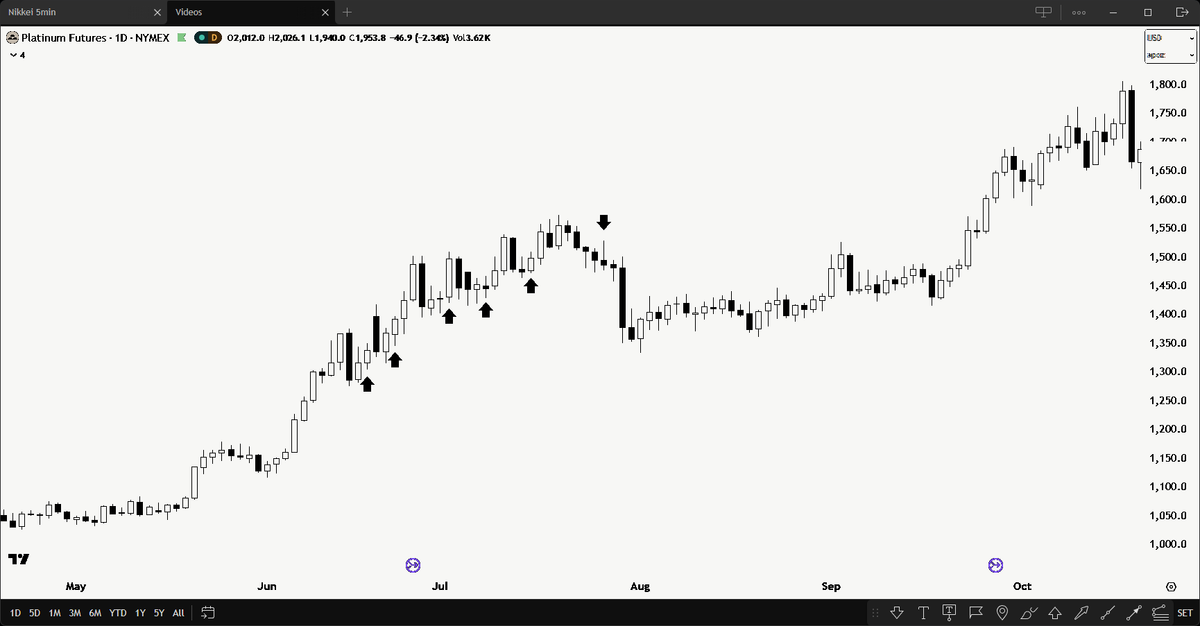
In a strong bullish trend, consecutive H1s succeed. Each H1 pushes to a new high, and the next H1 pushes to a new high after that. That sequence communicates that momentum is strong — and it sets up an expectation.
Once that expectation is established, traders anticipate a new high every time an H1 forms. That anticipation is itself being traded. It creates a defined basis for participation — and for reading when the trend is starting to lose strength. A trend producing consecutive H1 successes is behaving very differently to one where H2s are appearing regularly.
The candlestick criteria from Lessons 1 and 2 — strong bars, momentum gaps, the absence of wicks (shaved bars) — are the individual expressions of strength. Consecutive H1 or L1 successes are the structural expression of that same strength. They belong on the same "signs of strength" list.
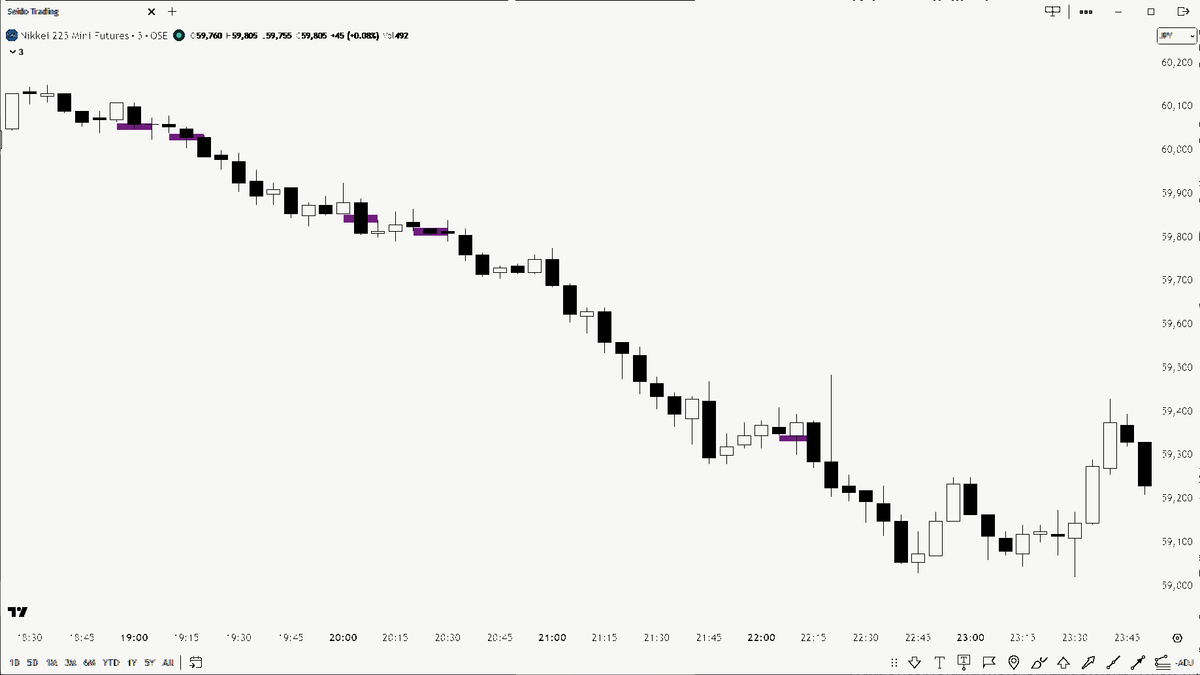
Disappointed Traders and Failed Expectations
Markets tend to continue doing what they have been doing. That is how traders establish expectations — and it is those expectations that get traded. When a trend is producing consecutive H1 successes, traders are not just observing that. They are positioned around it.
When traders have a defined expectation — that an H1 will succeed, because every prior H1 in the trend has succeeded — and that expectation is not met, those traders are disappointed. They were positioned for an outcome that did not occur. That disappointment does not disappear. It shows up in the price action that follows.
A failed H1 is not just a signal that the trend may be weakening. It means there is a group of traders who expected a new high, positioned for it, and are now holding a potentially losing trade. How they respond — whether they hold, exit, or reverse — contributes to the price action that follows.
A failed H1 can provide an L2 for the bears. A failed L1 can provide an H2 for the bulls. Traders on the other side of the market are watching exactly this. They will often wait for the second attempt to reverse price before committing — an L1 in a strong bull trend or an H1 in a strong bear trend carries different risk to the same pattern in a weakening move.
What to remember from this lesson
- Bar counting calibrates the strength of momentum and reads the eagerness of market participants. It applies to momentum only — not inside an extended trading range.
- A pullback is any candle that trades below the prior bar's low in a bull trend, or above the prior bar's high in a bear trend. The H1 is the first new high after a pullback. The L1 is the first new low.
- An H2 occurs when a second pullback happens before the reference high is exceeded. It is not a sign of weakness on its own, but it tells traders the bulls needed two attempts. The count resets once the reference high is traded through.
- Consecutive H1 successes signal strong momentum. That sequence creates a defined expectation — and a defined moment when the expectation fails. When a count reaches H3 or beyond, the HTF context carries more weight than the count.
- A failed H1 creates a group of disappointed traders who were positioned for an outcome that did not occur. Their response contributes to what follows. A failed H1 can provide an L2 for bears; a failed L1 can provide an H2 for bulls.
- Reading the expectations of market participants — and what happens when those expectations are not met — is a framework that applies at every stage of a move, not only in bar counting.
Annotation Checklist
- Strong bullish and bearish candles
- Swing closes and interaction observations
- Significant gaps within momentum areas
- Shaved bars
- Momentum area
- Trading range area
- Climax / exhaustion candles
- Trendlines (only where clearly defined)
- 20 EMA and HTF EMA interactions
- First EMA pullback after a momentum leg
- Consolidation range
- Momentum out of the trading ranges
- Retest levels
- Late-trend consolidation
- Measured move targets
- Prior day high and low (pHOD / pLOD)
- 50% retracement levels
- Current day open, high, and low
- Levels where confluence occurred
- H1 / L1 / H2 / L2 — counted within momentum areas. Failed counts noted.
Coursework
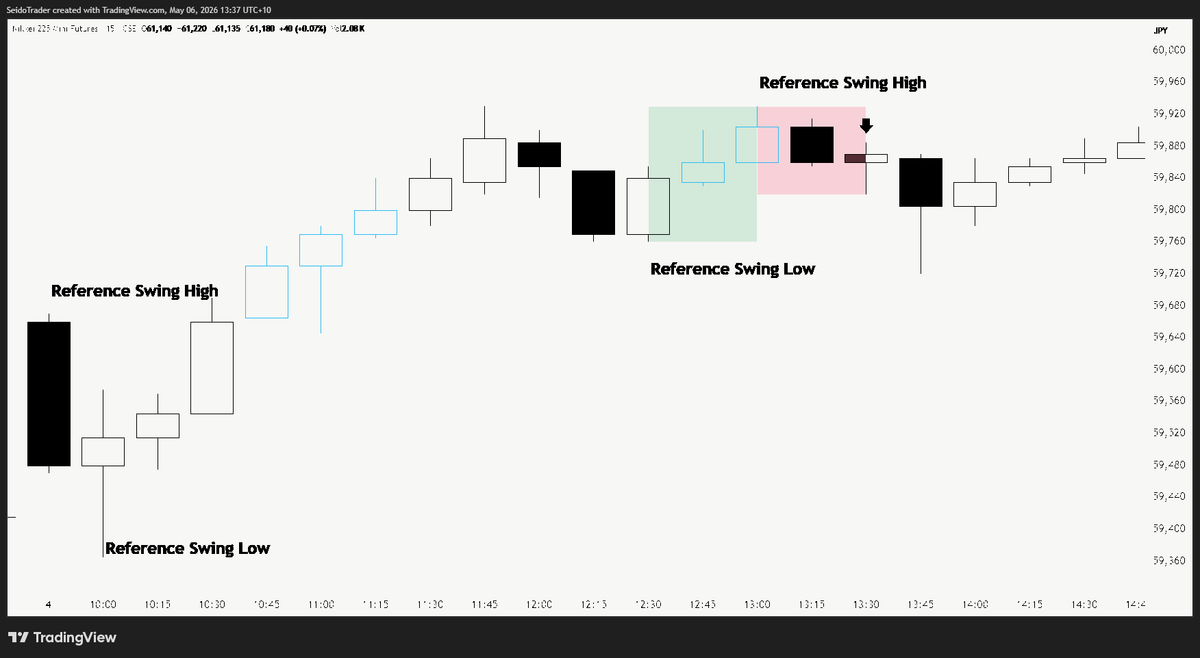
Identify periods of clear momentum on a chart — that is where bar counting applies. Within those periods, practice the count. Find the pullbacks, identify the H1s and L1s, and note where the count moves to H2 or L2. Observe what the candle behaviour looks like at each stage, and how the same period appears on the higher timeframe.
- Look at whether H1s and L1s on the higher timeframe are more consistently respected once momentum is established, compared to those on the lower timeframe. This connects directly to the HTF work in Lesson 6.
- Find periods where consecutive H1 or L1 successes are followed by a failure. Where in the trend did that failure occur? What did the candles look like leading into it? Was momentum weakening?
- Look at what else is visible around the count — inside bars, trading range candles, pullbacks that go deeper than expected.
- Continue annotating charts with everything covered across the series. The detail visible in price action should be increasing — more context, more connection between what each bar is communicating and the structure it sits within.
- When moving to the higher timeframe, check whether the momentum identified on the lower timeframe is visible above. That alignment is where the read becomes most reliable.
What Comes Next
Nine lessons. Nine connected ideas. Candlesticks, momentum, trends, strategy, consolidation, higher timeframe context, measured moves, levels, and bar counting. These are not separate tools — they are one read of the market, built layer by layer.
Consistent chart annotation builds the pattern recognition that makes price action readable in real time. What took deliberate effort early in the series will become instinctive over time — but only through sustained engagement with charts.