Every candlestick chart has two axes: a price scale and a time scale. The rate at which price changes over time matters. After momentum appears, price consolidates in one of two ways — through price, as a pullback or retracement, or through time, as sideways movement.
Momentum-based consolidation patterns include what traders call pullbacks, flags, triangles, inside bars, dojis and trading ranges. In the context of momentum-based consolidation they should be grouped together — because the principle governing all of them is the same.
Any consolidation pattern is an opportunity for traders to enter with the trend without risking the full extent of the recent move. In a bull trend, it is an opportunity to buy lower.
Why Consolidation Patterns Work
The reason consolidation patterns are so powerful in response to recent momentum is the trapped traders dynamic — and the psychology of three groups of market participants.
- Traders who bought early and are in profit are looking to add to their position. They are confident the trade is working.
- Traders who missed the move are trapped out. They are looking to buy at a better price.
- Traders in a losing position are trapped in the wrong direction. They are looking for a chance to exit for a smaller loss.
When the consolidation pattern breaks out again, traders who are still waiting are forced to respond — and that response drives the next leg of momentum.
Consolidations Are Trading Ranges
Here is the core principle of this lesson: every consolidation pattern is a trading range. The shape does not matter. Whether it is a flag, a triangle, an inside bar, a doji, or a period of sideways movement — they are all the same thing. Price is moving between a high and a low while the three groups of traders are making decisions.
This simplifies how traders respond to them. Rather than treating each pattern as a separate setup with its own rules, traders are always asking the same question — where is the high of this range and where is the low?
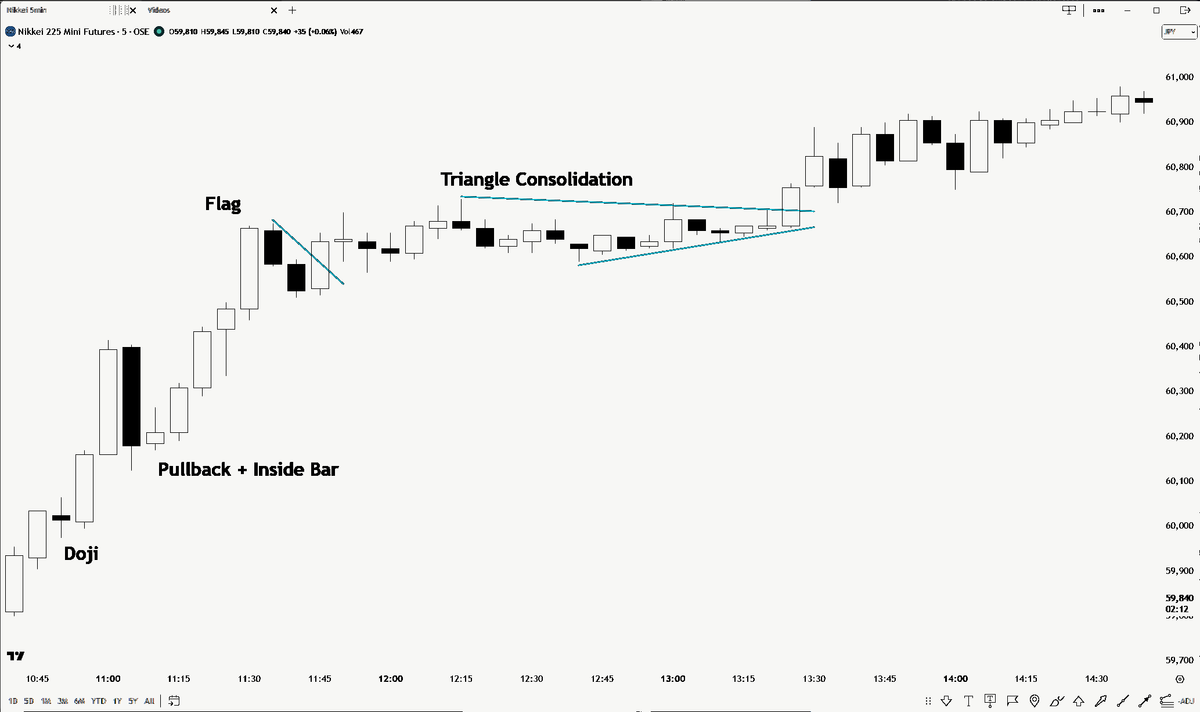
Buy Low, Sell High
If every consolidation is a trading range, the entry principle is always the same. In a bullish context — after momentum to the upside — traders buy toward the low of the consolidation range. In a bearish context — after momentum to the downside — traders sell toward the high of the range.
The pattern type is irrelevant beyond general awareness. The principle of how traders interact with the range does not change.
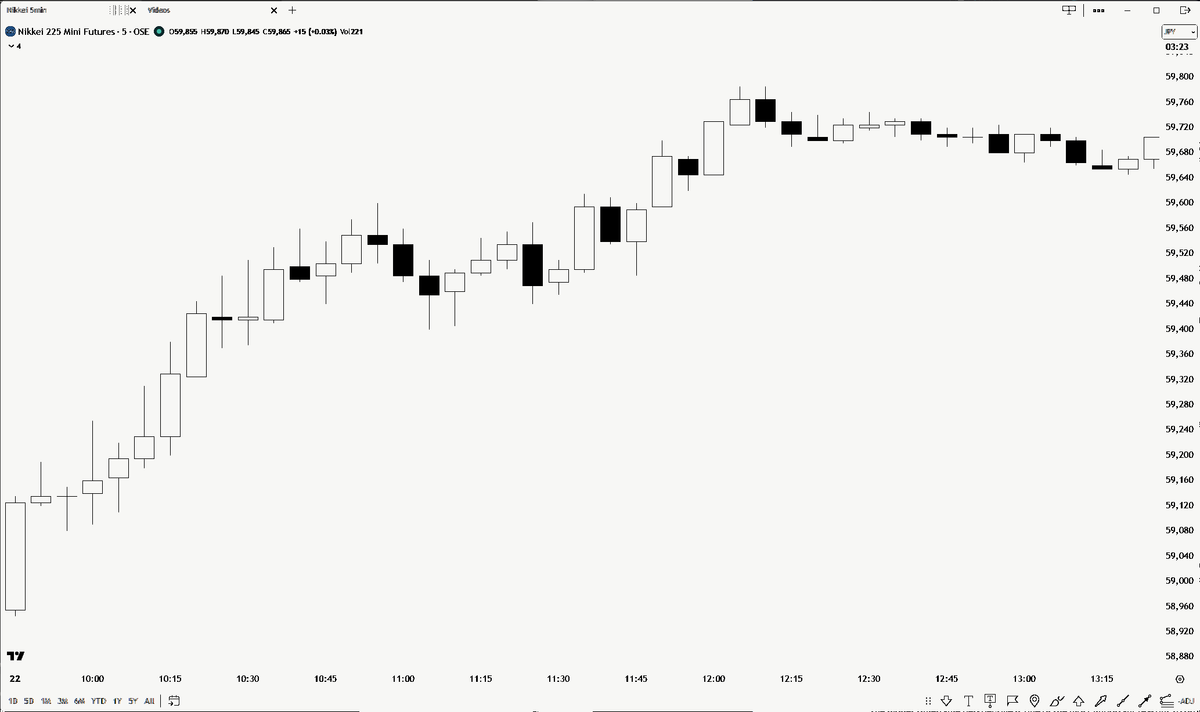
Consolidation Breakouts
Consolidation patterns end when price moves with clear momentum out of the range. This is the point at which stop placement becomes defined.
A consolidation pattern that does not break out with clear momentum is likely evolving into a larger trading range. In these scenarios, traders continue to apply the same buy-low, sell-high principle — assessing whether price is adhering to range rules or whether they are chasing momentum.
Retests
After a breakout, price will often return to the level it broke from. This is normal behaviour and is not a failure of the setup. Traders who recognise this avoid moving their stop prematurely — those who don't are often stopped out of a valid trade.
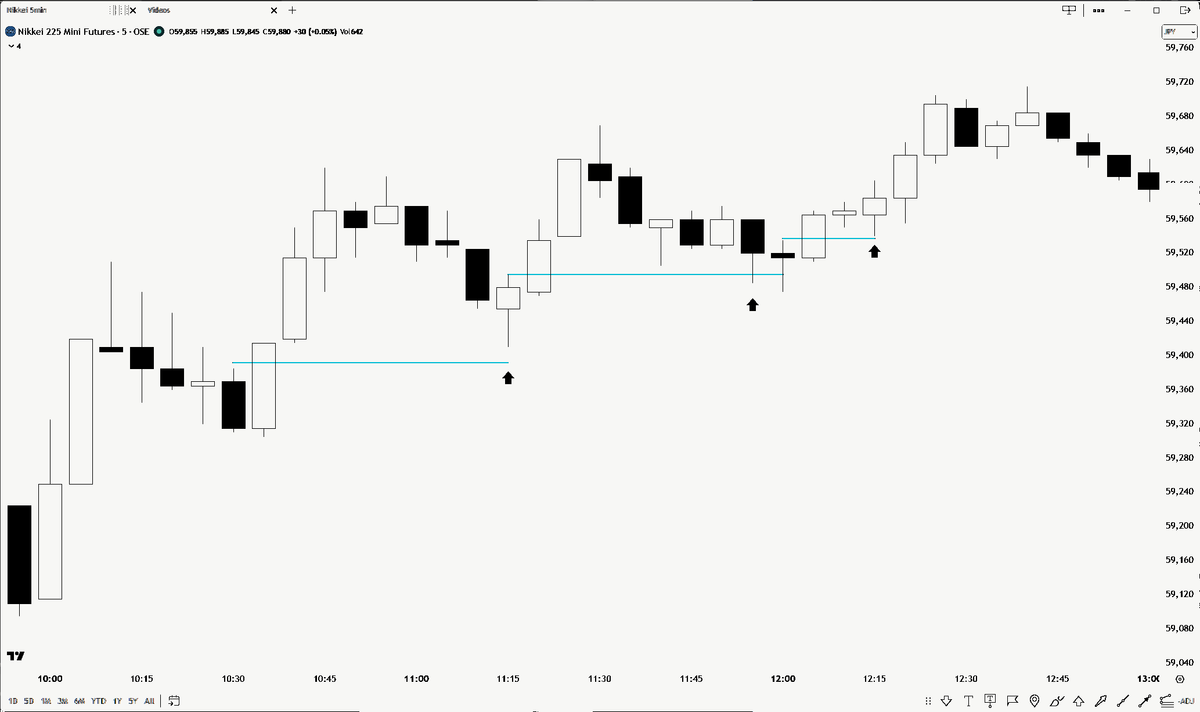
The Same Story at Different Scales
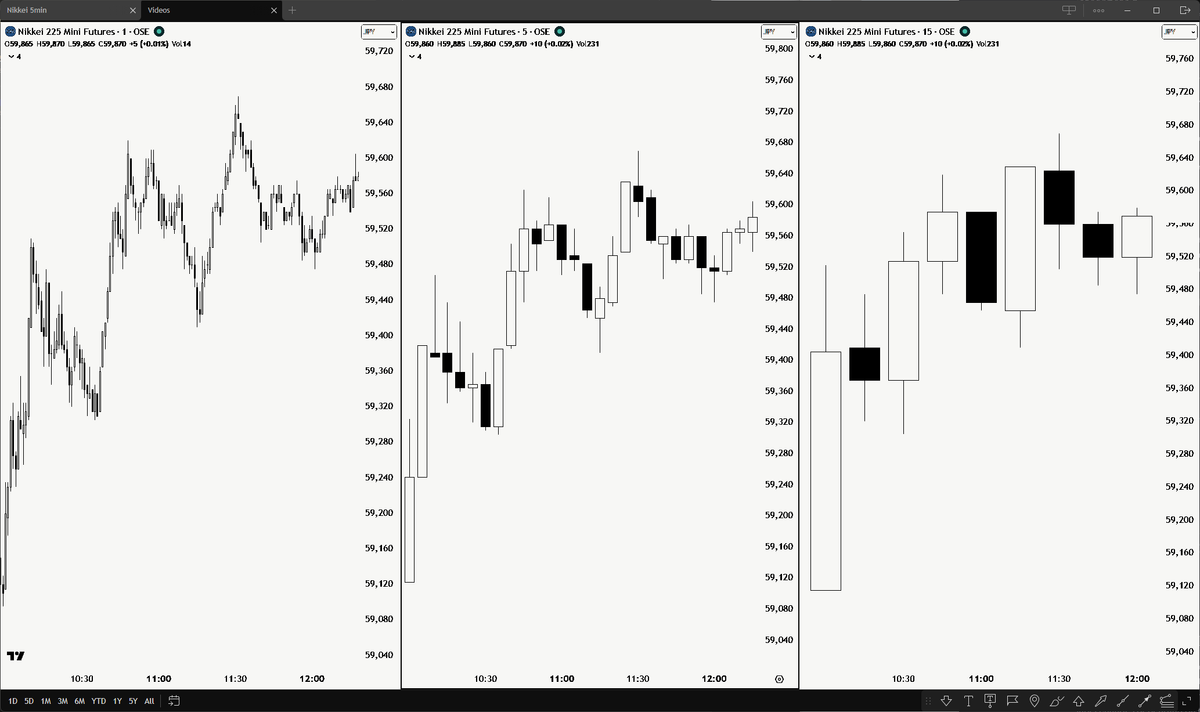
The higher timeframe perspective is one of the most important reasons to group all consolidation patterns together. A flag on a 5-minute chart may be an inside bar on a 15-minute chart. A flag on a 15-minute chart may appear as an inside bar on the daily. The pattern label changes depending on the timeframe. The principle does not.
Every consolidation is still a trading range. The three groups of traders are still present. The high and the low still define the range. The scale is the only thing that changes.
Market Cycles — An Honest Warning
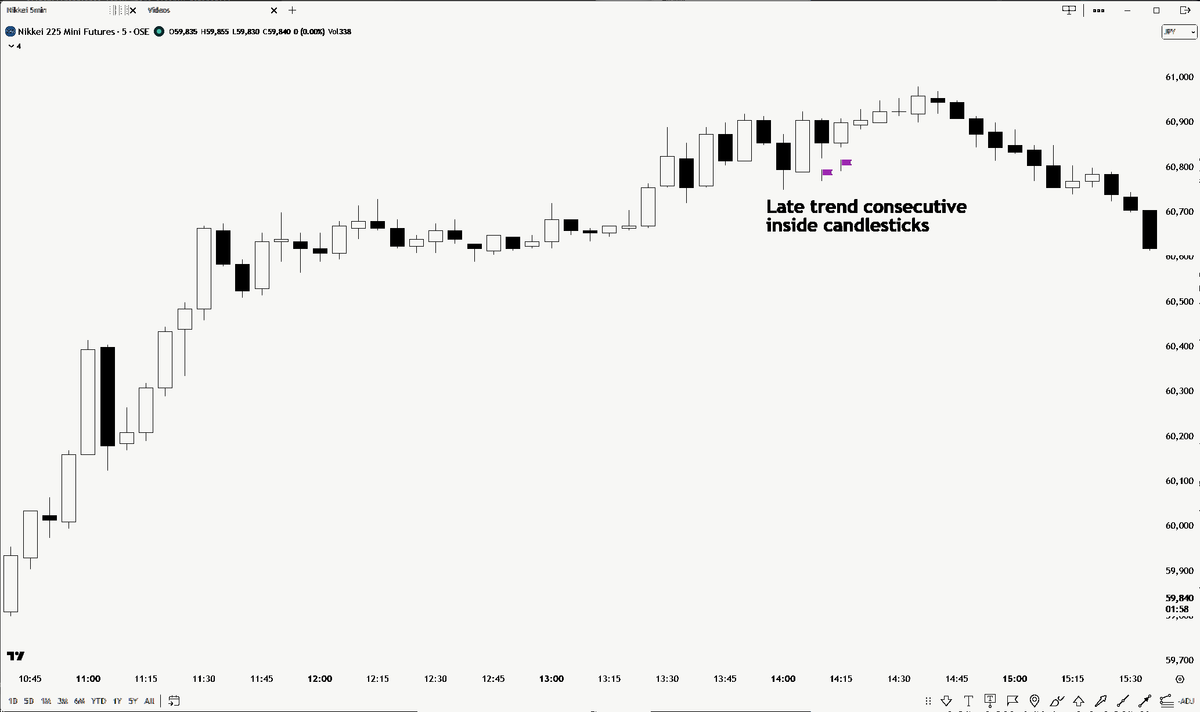
Momentum does not continue indefinitely. Price transitions through market cycles, and understanding where price is in that cycle is just as important as being able to identify the patterns themselves. A consolidation late in an extended trend carries different weight than a consolidation early in a new move.
Two consecutive inside bars appearing after a long directional run often represent the final consolidation before a reversal — it's often a trap for trend-following traders. Price may attempt to break in the direction of the trend, but the move is too extended to hold. Traders who recognised this were placing orders against the expected breakout direction, expecting it to fail.
Understanding where price is in the cycle determines how traders respond. It is also crucial for understanding where traders place their stops — and why certain levels attract the reactions they do.
What to remember from this lesson
- Every consolidation — regardless of shape — is a trading range defined by a high and a low.
- Three groups of traders drive every consolidation: early longs adding to positions, traders who missed out waiting to buy, and trapped short traders looking to exit.
- Entry logic is always the same: traders buy toward the low of the range in a bullish context; traders sell toward the high in a bearish context.
- A breakout with momentum defines the stop. Retests of the breakout level are normal behaviour, not failure signals.
- The same consolidation appears as a different pattern at different timeframes — the label changes, the range structure does not.
- A consolidation late in an extended trend carries different weight — it is often a trap, not a continuation opportunity.
Annotation Checklist
- Strong bullish and bearish candles
- Swing closes and interaction observations
- Significant gaps within momentum areas
- Shaved bars
- Momentum area — boxed or highlighted (green)
- Trading range area — boxed or highlighted (pink)
- Climax / exhaustion candles
- Trendlines (only where clearly defined)
- 20 EMA and HTF EMA interactions
- First EMA pullback after a momentum leg
- Consolidation range — high and low marked with a box
- Momentum out of the trading ranges
- Retest level — price returning to the breakout level
- Late-trend consolidation — note how price behaved on both LTF and HTF
Coursework
Your coursework for this lesson is to add consolidation patterns to your chart annotation checklist.
- Start by identifying whether your market is trending or in a trading range.
- Find periods of momentum and look at how price consolidated. For each consolidation you identify, mark the high and the low of the range.
- Once annotated on your lower timeframe, switch to the higher timeframe in TradingView with those annotations still visible. Observe where the consolidation sits in the bigger picture and how it reads at that scale.
- Note what type of pattern the consolidation appears as on the higher timeframe chart.
- Remember — the higher timeframe shows how lower-timeframe price action is being expressed at a broader scale. This helps you see how the same structure may be interpreted by participants operating on different timeframes.